
CanDo Laundry Services: Commercial Linen Hire & Laundry

Categories
Workwear & Uniforms

How Often Should Chef Whites Actually Be Changed During a Shift?

October 2026

How Often Should Chef Whites Actually Be Changed During a Shift?

The answer isn’t “once a day” — and treating it that way is costing you on hygiene and on fabric life.

how often should chef whites be changed — CanDo Laundry Services

A chef jacket looks fine from the pass. It’s covered in flour, oil splashes, and whatever walked through the door at 6am by the time service ends. The question kitchen managers actually need answered isn’t “how do we get whites clean” — it’s “how often do we need to change them before they’re a hygiene problem rather than a cosmetic one”. Here’s the straight answer, and what drives it.

Change at the point of visible contamination, not at the end of shift

The rule that matters is simple: a jacket gets changed the moment it’s visibly soiled with raw product, blood, grease that’s soaked through, or anything that’s come into contact with raw meat, fish or eggs. That can happen twenty minutes into a shift or not at all. It isn’t a clock-based decision.

For a split shift — lunch service then dinner service with a gap between — most kitchens change whites between the two, even if the jacket still looks reasonably clean. Eight hours of standing over a stove, prepping, and handling raw ingredients is enough for bacterial load to build on fabric even without a visible stain. That’s the standard most environmental health officers expect to see followed.

One change per service is the baseline; high-risk kitchens need more

For a single continuous service — most lunch or dinner shifts — one set of whites covering the whole shift is normal practice, provided nothing contaminates it along the way. Where it changes:

Raw meat and fish prep sections should have an apron or jacket change built into the move from raw prep to plating, not just a wash of hands. Cross-contamination from uniform to finished plate is a real route, and it’s one inspectors look for specifically.

Double shifts — split lunch and dinner — need a fresh jacket for the second service as standard, not as an exception.

Pastry and bakery sections often run cleaner for longer since they’re working with dry ingredients, so a full-shift jacket is usually fine unless something spills.

If your kitchen runs restaurant linen through an outsourced service, this changeover frequency is exactly what should be driving your par stock calculation — not the other way round.

Working out how many sets each chef actually needs

This is where most kitchens under-order and then wonder why whites look tired within a few months. A chef working five shifts a week, changing once per shift with the possibility of a mid-shift change on a bad day, needs enough stock to cover:

One set in use, one set in the wash cycle, and one set as a spare for the inevitable spillage or double-shift day. That’s a minimum of three sets per chef as a working estimate, not a guarantee — kitchens with heavier soiling (grills, fryers, butchery) often run four. Fewer than that and you end up either reusing visibly soiled whites because there’s nothing else on the rail, or paying rush charges to get stock back faster than the wash cycle allows.

Front-of-house aprons and side towels follow a similar logic but wear out faster — they take the brunt of spills and get balled up and stuffed in a drawer between changes far more than jackets do.

What skipping the changeover actually does — to hygiene and to the fabric

Two things go wrong when changeover gets skipped to save time or stock.

The hygiene risk is the obvious one. Under the Food Safety Act and general FSA guidance on food hygiene, uniform cleanliness is part of the broader contamination control picture inspectors assess, alongside handwashing and surface cleaning. A jacket that’s carried raw chicken juice through three hours of service and then handled a finished plate is a documented contamination pathway, not a hypothetical one.

The fabric damage is less obvious but it’s the one that costs money. Grease and protein stains that sit on cotton-poly whites for a full double shift set harder than stains that get into a wash within hours. That means more aggressive washing to shift them — higher temperatures, longer cycles, sometimes pre-treatment — which breaks down fibres faster. A jacket that could have lasted eighteen months of normal washing starts yellowing and thinning in under a year because every wash is fighting baked-in stains instead of fresh ones. We’ve covered why chef whites go yellow in more detail elsewhere on the site, but the short version is: the longer contamination sits, the harder the wash, the shorter the garment life.

Building changeover into the laundry schedule, not against it

The practical fix is matching your laundry collection frequency to your actual changeover rate, not the other way round. If chefs are changing twice a day on double-shift days, a once-a-week collection means stock sitting dirty in a bag for up to six days before it’s even in the wash — which defeats the point of changing promptly in the first place.

Kitchens that get this right usually run a daily or alternate-day collection matched to a three-to-four set par stock per chef, so there’s always a clean jacket on the rail regardless of what the previous shift threw at it. It’s a conversation worth having directly with whoever supplies your whites — the collection schedule should be built around how your kitchen actually gets dirty, not a generic weekly slot.

Getting changeover frequency right isn’t about buying more uniforms — it’s about matching stock levels and collection timing to how your kitchen actually runs. If you’re not sure whether your current par stock and schedule add up, get a quote and we’ll work through the numbers with you.

Not sure your chef whites stock adds up?

We’ll look at your shift pattern, soiling levels and collection schedule and tell you honestly whether your par stock is right.
Get a Free Assessment →


Restaurant & F&B
Categories
Guides & Tips

Why Does Scraper Mat Backing Crack or Curl at the Edges Before the Mat Wears Out?

October 2026

Why Does Scraper Mat Backing Crack or Curl at the Edges Before the Mat Wears Out?

The pile still looks fine. The backing is the part that’s actually failing.

scraper mat backing cracking — CanDo Laundry Services

You bought a decent scraper mat eighteen months ago. The surface fibres are still gripping dirt off boots fine, but the edges have started to lift and the rubber underneath has gone brittle and cracked across the middle. It’s now a trip hazard instead of a safety feature, and it’s happened long before the mat should have worn out. This is one of the most common reasons entrance matting gets replaced early, and it’s almost never down to foot traffic. It’s down to what’s happening underneath the mat, not on top of it.

The backing fails because of heat, not footfall

Rubber-backed mats crack for one main reason: repeated heat cycling. Entrance mats sit directly in the path of sun through glass doors, warm air blasting from above-door heaters, or underfloor heating running beneath them. The rubber expands and contracts every single day. Do that for a year and the compound hardens, loses flexibility, and splits along the stress lines — usually right where the mat flexes most, which is the middle and the corners.

Cheap mats use a thinner, lower-grade rubber compound that can’t take this cycling. A mat backed with proper nitrile or PVC compound built for commercial entrances will handle years of this without going brittle. If your mats are failing inside two years, the backing spec is the first thing to question — not the pile quality.

Curling edges mean moisture is getting underneath

Edge curl is a different problem with a different cause. It happens when moisture gets trapped between the mat backing and the floor, usually because the mat is wet-mopped around rather than lifted and cleaned properly underneath. Water sits against the rubber, the backing swells slightly at the point of contact, and once it dries unevenly the edge lifts and stays lifted.

This is worse in entrances that get a lot of wet-weather foot traffic — exactly the mats covered in our guide to keeping scraper mats from failing in wet weather. If nobody’s lifting the mat to clean and dry the floor beneath it on a regular cycle, curl is almost guaranteed within a season or two.

Cleaning method matters more than cleaning frequency

Jet-washing a scraper mat sounds like the obvious way to get it properly clean, but high-pressure water forced into the seam between pile and backing is one of the fastest ways to delaminate a mat. The bond between the rubber base and the fibre layer isn’t designed to take direct pressure washing at close range. Once that bond starts to separate, the backing cracks faster because it’s no longer being held flat and supported by the fibre layer above it.

Vacuuming daily and a proper deep wash on a managed rotation does the job without stressing the bond. This is one of the arguments for a mat rental and laundering service over buying and cleaning in-house — the wash process is controlled, and a mat showing early signs of backing failure gets swapped out before it becomes a hazard rather than left in service because it was an expensive purchase.

Storage and handling between washes causes damage too

Mats stacked flat while damp, or rolled tightly and left in a cupboard for weeks, develop permanent creases and stress points in the backing. Rubber that’s folded under weight while it’s not fully dry sets into that shape. When you unroll it and lay it flat again, the crease becomes a weak point that cracks first.

If you’re managing matting in-house across multiple entrances, store spares flat, not rolled, and make sure anything going into storage is completely dry first. It sounds minor. It’s one of the most common avoidable causes of early backing failure we see when we take over a site that was previously self-managed.

What this means for replacement timing

A scraper mat’s realistic working life depends far more on backing condition than pile condition, which is why checking only the surface when deciding whether to replace a mat is the wrong test. Run a hand along the underside edge every few months. If it’s gone stiff, started to flake, or the edge has lifted more than a few millimetres off the floor, that mat is on borrowed time regardless of how the top looks.

For sites managing their own matting, this usually means replacing mats on a rougher schedule than necessary — either too early, because nobody’s checking the backing and they replace on a blanket timeline, or too late, because the surface still looks fine and nobody thinks to check underneath. A managed rotation takes that judgement call away from site staff entirely.

Stop guessing when a mat needs replacing

Our logo mat and scraper mat rental service rotates matting on a managed cycle, so backing failures get caught and swapped before they become a trip hazard at your entrance.

Get a Free Assessment →


Floor Mats
Entrance Matting
Facilities Maintenance
Categories
Guides & Tips

Scraper Mats Freezing or Icing Over in Winter? How to Keep Entrance Matting Safe in Cold Weather

October 2026

Scraper Mats Freezing or Icing Over in Winter? How to Keep Entrance Matting Safe in Cold Weather

Wet mats and sub-zero mornings are a slip claim waiting to happen — here’s how to stop it.

entrance mats freezing winter — CanDo Laundry Services

A scraper mat soaked from last night’s rain, left outside a doorway overnight, can freeze solid by 7am. The fibres stiffen, the backing goes rigid, and instead of scraping grit off boots it becomes a sheet of ice with a pattern on it. Swap frozen or iced-over mats before opening, and move wet mats to a covered or heated entrance overnight wherever you can — that single change prevents most winter matting incidents. The rest of this article covers how to set that up without adding to your morning workload.

Why mats freeze faster than the pavement around them

Matting holds water. That’s the entire point of it — pulling moisture off shoes and wheels so it doesn’t track inside. But a saturated mat has far more surface water sitting in it than bare concrete does, and water in fibre loses heat quicker than water on a solid surface. On a cold, clear night, a wet mat can drop below freezing well before the ground does.

The result is a mat that looks fine from a distance but has a layer of ice bonded into the pile. Someone steps on it expecting grip and gets none. If your entrance also has a rubber scraper mat outside and a logo mat just inside, check both — the outer one freezes first, but a damp logo mat near a draughty door isn’t far behind.

The overnight routine that actually prevents it

Three things work, in order of effort:

Bring mats inside at close, where that’s practical. A mat stored in a dry back-of-house area overnight can’t freeze. For sites with a lobby or vestibule, even moving the outer mat a few feet under cover breaks the direct exposure to frost.

Keep a dry spare on standby. If you run a mat rental or hire service, you should have a second set to rotate in when the first is wet through — not just for hygiene, but so there’s always a dry mat to put down on a frozen morning instead of trying to de-ice the one that’s already down.

Check before opening, not after a complaint. Build a thirty-second entrance check into the opening routine from November to March: is the mat flat, dry enough to grip, and free of visible ice at the edges. It costs nothing and it’s the one step that catches the problem before a guest or customer does.

What to do when a mat is already frozen

Don’t pour hot water on it — it refreezes within minutes and makes the surface worse than before. Lift the mat, if it’s safe to do so, and replace it with a dry one. Leave the frozen mat somewhere it can thaw and drain properly before it goes back down. If you don’t have a spare, a hazard sign and temporary cordon at that entrance beats a slip in reception.

This is where rental matting earns its keep over a mat you bought once and never replaced. A rotation service means a fresh, dry mat arrives on schedule rather than you trying to dry one yourself overnight on a radiator.

Matting type matters more in winter than summer

A standard coir scraper mat holds water well but dries slowly — it’s the one most likely to be iced through by morning. A rubber-backed scraper mat with raised ribs sheds more water and drains faster, so it’s less prone to a solid freeze, though it can still ice at the edges. Anti-fatigue and logo mats indoors aren’t exposed to frost directly, but condensation from a cold entrance door can leave them damp enough to be a different kind of slip risk — worth checking on the same morning routine rather than assuming indoor means dry.

If your entrance gets heavy footfall and genuine winter weather — exposed doorways, north-facing entrances, anywhere that doesn’t get direct sun — it’s worth asking your matting provider whether a higher-absorbency or faster-draining mat for the winter months makes sense, even if you switch back for summer.

Who’s liable if someone slips on a frozen mat

If the mat was visibly iced over and nobody checked it before opening, that’s a straightforward failure of reasonable care under the Occupiers’ Liability Act, and it will look that way to an insurer too. A dated record of your winter matting checks — even a simple tick-sheet at the till or reception desk — is cheap insurance against a claim that boils down to “you should have noticed.” The same logic applies to any front-of-house area where guests and customers walk, which is why hotels and restaurants with hotel laundry contracts often fold matting checks into the same housekeeping routine as linen counts.

None of this is complicated, but it has to be routine rather than reactive. A mat that freezes once in December and gets noticed by a guest is a problem that was preventable in November.

Keep your entrance safe through winter

CanDo supplies and rotates scraper, logo and anti-fatigue matting across the UK, with spare sets ready for exactly this kind of weather.

Get a Free Assessment →


Floor Mats
Categories
Guides & Tips

How Many Towels Does a Gym Changing Room Actually Need Per Day?

October 2026

How Many Towels Does a Gym Changing Room Actually Need Per Day?

The formula gym managers skip, and why Monday morning is when it falls apart.

gym changing room towel par levels — CanDo Laundry Services

You run out of towels at 6pm on a Monday, again, and the evening shift spends an hour apologising to members instead of cleaning equipment. If you’re searching for gym changing room towel par levels, you already know the real question isn’t “how many towels do we own” — it’s “how many clean towels are actually available at the point someone needs one”. Here’s how to work that number out properly, instead of guessing and topping up every few months when complaints pile up.

The basic formula

Par stock for towels comes down to three numbers multiplied together: average daily towel usage, the number of days in your laundry cycle, and a safety margin.

Start with usage. Count towels issued on a typical weekday and a typical weekend day for two weeks — most access control systems log this if you issue towels at the desk, or do a manual tally if you don’t. Take the average of your busiest three days, not the overall average. Gyms that size to the average, not the peak, are the ones running short on Mondays and Saturday mornings.

Multiply that peak daily figure by your full laundry cycle in days — collection to clean return, not just wash time. Then add 20–30% as a buffer for no-shows, damaged stock, and the odd member who takes two towels. That total is your par stock.

Worked example: a 1,500-member gym

Take a mid-sized gym issuing one towel per visit, with 220 peak-day visits. On a three-day laundry cycle — collected Monday, returned Thursday — you need enough towels to cover Monday, Tuesday and Wednesday’s usage before the clean batch comes back.

That’s 220 towels per day × 3 days = 660, plus a 25% buffer, which comes to roughly 825 towels in circulation. Cut the laundry cycle to a next-day turnaround and the same gym only needs around 285 towels doing the same job. The cycle length matters more than the member count — it’s the lever gyms underestimate.

Why Monday is always the problem

Most gyms collect laundry once over the weekend, which means Monday and Tuesday are running off stock that’s been sitting since Friday afternoon’s peak. If your weekend numbers spike — and in most leisure centres they do — your Monday par stock needs to absorb Saturday, Sunday and Monday demand from a single collection. Build your buffer around your actual weekend peak, not your weekday average, or every Monday evening looks the same.

The fix is usually a mid-week or twice-weekly collection rather than buying more towels to paper over a cycle that’s too long. More stock sitting in a cupboard doesn’t fix a bottleneck — it just delays when you notice it.

Hire vs owning your towel stock

Gyms that own their towels outright carry the full par stock calculation as capital sitting in a cupboard, plus replacement cost when towels go thin from chlorine or pool use — a problem that affects spa and pool towelling just as much as gym towels. Hired stock shifts that par-stock maths onto the laundry provider: you pay for what moves through the cycle, and running short on a bank holiday Monday becomes their problem to solve, not yours.

For a single-site gym with predictable numbers, owning towels outright can still work out cheaper over several years. For a multi-site operator, or anywhere with a sharp weekend peak, hired stock with a flexible collection schedule tends to absorb spikes better than a fixed owned-stock pile ever will.

Signs your par stock is wrong, not your laundry

Before blaming a laundry provider for running short, check whether the number was ever right in the first place. Three signs point to a par-stock problem rather than a supplier problem:

You’re topping up stock every few months. That’s not wear and tear — that’s a par level set below actual peak demand from day one.

Shortages cluster on specific days. If it’s always Monday or always the first Saturday of the month, that’s a collection-schedule mismatch, not a quantity problem.

Front desk staff are rationing towels. If staff are quietly limiting towels per member before 10am, your par stock is already below the line and everyone downstream is covering for it.

Run the usage count again, be honest about your actual peak day rather than your average, and rebuild the number from there. It’s the same logic hotels use for bed linen par stock and restaurants use for napkin stock — the formula doesn’t change, only the usage pattern does.

Getting gym towel par levels right is one part headcount maths and one part being honest about your laundry cycle length — most shortfalls come from the second, not the first. If you want help working through the actual numbers for your site rather than a rule of thumb, get a quote from CanDo and we’ll walk through your usage pattern and collection frequency together.

Not sure what your towel par stock should be?

We’ll work through your peak-day numbers and laundry cycle with you — no guesswork, no overselling.

Get a Free Assessment →


Sports & LeisurePar StockGym Towels
Categories
Healthcare

Why Does Dental and Vet Practice Laundry Keep Coming Back With Rust Stains?

October 2026

Why Does Dental and Vet Practice Laundry Keep Coming Back With Rust Stains?

Orange-brown marks on gowns and coverings usually come from three places — and only one of them is your laundry’s fault.

rust stains on dental and vet laundry — CanDo Laundry Services

You unpack a delivery of clean gowns or table coverings and spot an orange-brown mark that was not there before. First instinct is to blame the laundry. Sometimes that is fair. More often the rust is coming from inside your own practice, and the answer to rust stains on dental and vet laundry depends on which of three sources is responsible: the washing machine itself, the water supply, or metal that should never have gone in the bag in the first place.

Check the instruments bag first

This is the most common cause and the easiest to miss. A dropped probe, a bur, a paperclip holding a chart, or a staple from packaging can end up folded inside a gown or table covering. Once it is tumbling in a hot wash with steel on fabric, you get a small localised rust mark that looks nothing like a metal object — just a stain.

Before bagging anything for collection, give table coverings and gowns a quick shake and a visual check. If you are laundering dental bibs or vet practice coverings that go through multiple hands during a procedure, build the check into your end-of-procedure routine rather than leaving it to whoever ties the bag at the end of the day. We cover what should be bagged separately for infection control reasons in our healthcare laundry guidance, and the same discipline catches stray metal as a side benefit.

Rule out your own washing machine

If you run laundry in-house rather than outsourcing it, the drum itself is a common culprit. Washing machine drums are usually stainless steel, but the outer tub, springs, or fixings behind the drum can be ordinary steel. Once that starts to corrode — from age, from a chipped enamel panel, or simply from years of hot washes — tiny rust particles get carried into the water and deposit on fabric as it spins.

The telltale sign is that the marks are not localised to one spot like a dropped instrument would cause. Instead you get fine speckling spread across several items in the same load, sometimes appearing gradually over weeks as the corrosion gets worse. If that pattern matches what you are seeing, the machine needs inspecting, not the laundry process.

Test for iron in your water supply

Less common in mains-fed practices but still worth ruling out, especially if you are on a private supply or an older building with ageing pipework. Iron bacteria or simple pipe corrosion can introduce dissolved iron into the water, which oxidises on fabric during the hot wash and dry cycle and leaves a rust-coloured tinge across whole loads rather than isolated spots.

A water test from your supplier or an independent lab will confirm this in a day or two. If iron is the cause, the fix sits with your plumbing or water treatment, not your detergent or your wash programme.

Why outsourcing removes most of this risk

A commercial laundry washing practice gowns and coverings at scale is running machines designed and maintained for continuous high-temperature use, with stainless components throughout and a maintenance schedule that catches corrosion before it ever touches a load. Water quality is monitored as part of the wash process, not left to whatever comes out of the practice tap. And because every load is sorted and checked before it goes into a machine, a missed instrument is far less likely to make it through unnoticed.

Under EN 14065, the standard that governs laundry hygiene and risk assessment, a laundry provider has to demonstrate control over exactly these variables — water, machine condition, and contamination risk — as part of its ongoing audit. That is a level of oversight that is hard to replicate with an in-house domestic or semi-commercial machine running alongside everything else in a busy practice.

If you are currently washing gowns and table coverings on-site and rust keeps turning up, it is worth weighing the cost of chasing down a corroding machine or retesting water quality against simply moving the whole process to a provider already built to manage it. Our workwear laundry service covers exactly this kind of clinical garment handling for dental and vet practices alongside wider healthcare uniform contracts.

What to do if rust has already set in

Rust is a different chemistry to most other stains — ordinary detergent and bleach will not shift it, and bleach can actually set an iron stain permanently by oxidising it further. A dedicated rust remover, usually an oxalic acid or sodium hydrosulphite-based product, is the only reliable route, applied before the item goes through a normal hot wash. For anything white and clinical-grade, a professional laundry will have the right product on hand; for anything already badly marked, replacement is often cheaper than repeated stain treatment that risks weakening the fabric.

Either way, treat a rust mark as a signal to check the source rather than a one-off. One rust stain is bad luck. Three in a month means something upstream needs fixing.

Stop chasing rust stains back to their source

Tell us what you’re seeing and we’ll help you work out whether it’s your machine, your water, or your process — and what outsourcing would actually change.

Get a Free Assessment →


Healthcare Laundry
Dental Practice
Veterinary Laundry
Categories
Guides & Tips

How Often Should You Change Entrance Mats?

October 2026

How Often Should You Change Entrance Mats?

The mat by your front door works harder than any other textile in the building. Here’s when to swap it.

Boots stepping through a puddle on the way in

Every visitor’s first ten steps land on your entrance mat. It catches rain, grit, oil, chewing gum and whatever else came off the car park. If nobody is tracking how worn it’s getting, it quietly goes from doing its job to becoming a slip hazard with a logo on it. So how often should you change entrance mats? The short answer: high-footfall entrances need a fresh mat every one to three days, and low-footfall sites can stretch to once or twice a week — but the number that matters more is the wear you can actually see.

The short answer: match the swap to footfall

Footfall drives wear faster than anything else. A hotel lobby or restaurant doorway with a few hundred crossings a day needs a mat change every one to three days to keep dirt from working into the pile and the backing.

A quieter site — a small office, a back-of-house corridor — can run a mat for a week between changes without it looking or performing badly. The mat still does its job of trapping moisture and grit; it just has fewer feet to deal with.

Sites like a busy hotel entrance or a restaurant front door see enough traffic that a fixed rota, rather than an ad-hoc check, is the only way to stay ahead of it.

Five signs your mat is already overdue

If you’re not on a rota yet, look for these before you decide a swap can wait:

Curling edges. A mat that’s lifting at the corners is a trip risk before it’s a hygiene one.

Visible tracking. A dark path worn through the centre means the backing is compressed and no longer gripping the floor properly.

A wet feel underfoot. Once a mat is saturated, it stops absorbing and starts transferring moisture straight onto the next pair of shoes.

A smell. Damp matting left too long picks up an odour fast, especially in warm, enclosed lobbies.

Flattened pile. If you press the mat and it doesn’t spring back, it’s stopped scraping and started just sitting there.

Weather doubles the wear

A dry summer week and a wet January week are not the same job for the same mat. Rain, road salt and mud all shorten the gap between changes.

Most sites need to roughly halve their swap interval through autumn and winter. A mat that lasted a week in July might need changing every three or four days once the weather turns.

Healthcare sites feel this particularly hard, since a wet or gritty entrance mat sits right next to footfall heading straight into clinical areas. A healthcare laundry provider that also handles matting can build the seasonal swap into the same collection round as linen, rather than leaving it as a separate job someone forgets.

Why a fixed rota beats waiting for a mat to look bad

Waiting until a mat “looks dirty” means you’re always one visitor behind the problem. By the time it looks bad, it’s already been underperforming for days.

A rental service on a fixed rota solves this by swapping mats on a set schedule rather than a judgement call. That’s the whole point of renting rather than buying outright: someone else is tracking the calendar, not your duty manager on a busy Friday.

For restaurants, this matters as much at the kitchen door as it does front-of-house. Oil and grease off a back entrance mat behave differently to rainwater, and a restaurant linen partner used to catering environments will usually put a different mat grade there anyway.

Entrance mats are a safety line item, not a décor one

The HSE’s guidance on slips and trips consistently flags wet or worn entrance flooring as one of the most common and most preventable causes of workplace injury claims. A tired mat isn’t just untidy — it’s a liability sitting at your front door.

Treat the swap schedule the same way you’d treat a fire extinguisher check: not glamorous, but the kind of thing you don’t want to discover has lapsed after someone’s gone over on it.

If your current mat rotation is running on memory rather than a schedule, that’s worth fixing before it costs you a slip claim. Get a quote from CanDo and we’ll work out a swap frequency that actually matches your footfall, not a generic default.

Get Your Entrance Matting Right

Tell us your footfall and we’ll set a swap schedule that keeps your entrance safe and presentable year-round.

Get a Free Assessment →


Floor Mats
Categories
Guides & Tips

Scraper Mats and Logo Mats Soaked Through? How to Stop Entrance Matting Failing in Wet Weather

October 2026

Scraper Mats and Logo Mats Soaked Through? How to Stop Entrance Matting Failing in Wet Weather

If your mats are dark and dripping by 10am, the problem is length and frequency, not the mat itself.

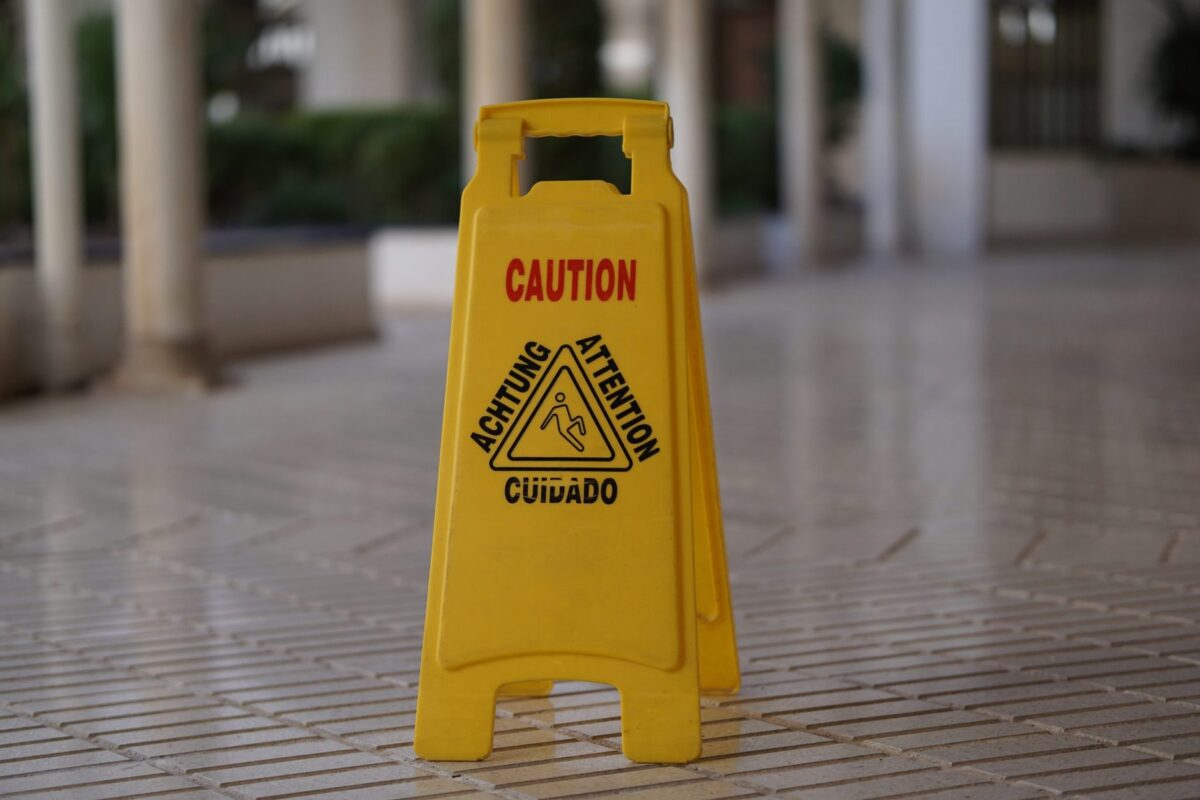
Caution wet floor sign on a tiled commercial entrance floor

You can tell within the first week of proper autumn rain whether your entrance matting is doing its job. If the mat inside the door is dark, squelching, and leaving footprints halfway across the lobby, it has already failed — and the floor behind it is now your problem. The usual fix people reach for is a thicker or more expensive mat. That is rarely what is actually wrong. In most cases it is one of two things: the matting run is too short, or it is not being changed often enough to dry out between uses.

How much matting length do you actually need?

The industry rule of thumb is that it takes between five and seven walked-on steps to get moisture and grit off a shoe sole. A single 1.5 metre mat gives someone two steps, maybe three. That is not enough matting for anyone walking in at a normal pace, let alone a pushchair or a trolley. For a main entrance with regular footfall, you want a minimum of three to four metres of matting length — that can be one long run or a scraper mat outside followed by a wiper mat inside, which is usually the better combination anyway.

Scraper matting is built to pull mud and grit off a sole; it is not designed to absorb much water. Wiper or dry-walk matting does the opposite — it holds moisture in its pile and lets grit settle to the base. Using scraper matting on its own in wet weather, without a wiper mat behind it, is the single most common cause of saturated entrance mats we see on site visits. For guidance on where scraper and wiper mats each belong, our piece on scraper mats vs entrance mats covers the distinction in more detail.

Why a mat that worked fine in summer fails in October

Mat saturation is not usually about the mat ageing badly. It is about volume. A mat rated to handle light summer footfall and the occasional shower reaches its absorbency limit much faster once every pair of shoes coming through the door is wet, not just damp. Once a mat is saturated, it stops absorbing and starts transferring — water and grit get pushed back onto the next shoe that steps on it, and from there onto your floor.

This is why the same matting plan that looked adequate in June can look completely inadequate by November. It is also why service frequency needs to flex with the season rather than staying fixed year-round.

How often should wet-weather mats be changed?

As a baseline, most commercial entrances on a standard contract have mats collected and exchanged weekly. Through a wet autumn and winter, that is not enough for a high-traffic main entrance. A mat that saturates by midday on a wet Tuesday is doing nothing for the rest of that week. For entrances taking heavy footfall in persistent rain, moving to a twice-weekly exchange for the wet months keeps a dry mat on the floor rather than a wrung-out one. Hotels and restaurants with a single main entrance are the ones that feel this hardest, since every wet mat there is visible to every arriving guest. Related reading: hotel laundry services that cover more than just linen.

If you are on a contract where frequency is fixed and does not flex seasonally, it is worth asking your supplier directly whether a temporary uplift is available for wet months. Most commercial matting providers, CanDo included, can adjust collection frequency for a defined period rather than locking you into one schedule all year.

Logo mats: the trade-off between branding and absorbency

Logo mats sit at the entrance for a reason — they are the first branded surface a visitor sees, and they do a genuine job for first impressions. But a printed logo mat usually has a shorter, tighter pile than a plain wiper mat, because the logo needs to stay crisp and visible. That shorter pile holds less moisture.

The fix is not to drop the logo mat. It is to position it correctly in the run — as the final, visible mat inside the door, with proper scraper and wiper matting doing the heavy lifting in front of it, outside and in the initial entrance zone. Treat the logo mat as the finishing piece, not the only line of defence, and it will do its branding job without taking on more moisture than its pile can handle.

Checking if your current matting plan is actually working

A quick way to check: walk your entrance at midday on a wet day, not first thing in the morning before the rain has properly started. If the mat at the door is dark through to the backing and the floor beyond it is damp or gritty, your current matting length and frequency are not matching your actual footfall and weather. Before paying for anything extra, measure the walked length of your current run in steps — if it is under five, that is your answer before you even look at service frequency.

Wet weather matting failures are nearly always a planning problem rather than a product problem — the fix is usually more matting length at the entrance and a tighter service schedule through the wet months, not a premium mat. If your current setup is leaving floors wet and grit-covered by lunchtime, get a quote and we’ll work out the right run length and collection frequency for your actual footfall, not a generic one.

Get your entrance matting right before winter

We’ll look at your footfall, your entrance layout and your current schedule, and tell you honestly what needs to change.

Get a Free Assessment →


Floor Mats
Categories
Healthcare

Care Home Linen Going Missing? Here’s Why — and How to Stop It

October 2026

Care Home Linen Going Missing? Here’s Why — and How to Stop It

Your par stock keeps shrinking and nobody can say where it’s going. It’s almost never theft.

care home linen loss — CanDo Laundry Services

You ordered enough sheets, pillowcases and towels to run comfortably. Six months later you’re short a third of them, staff are improvising with whatever’s left on the trolley, and the home manager is asking why you keep reordering stock that should already be there. Care home linen loss is rarely one dramatic event. It’s three small leaks running constantly, and once you know where to look, all three are fixable without spending more on stock.

Leak one: sluice and soiled-linen bags that never come back

Heavily soiled sheets and pads often get bagged separately for hygiene reasons, and that separate bag is where most linen disappears. If it’s not logged against a resident or a room before it leaves the building, nobody can match what went out against what comes back. Over a month that’s a handful of sheets. Over a year, on a 40-bed home, that’s a stock rebuild.

The fix is a simple log at the point of bagging — room number, item count, time — kept at the nurses’ station or sluice room, not relying on memory at the end of a shift. If you’re working with an external provider, ask how they reconcile soiled bags against delivery notes. A laundry operating to EN 14065 standards should already be able to tell you exactly what left your building and what came back clean, by weight and by item count, not just a total.

Leak two: linen that leaves with residents, families or agency staff

This is the quiet one. A resident is admitted to hospital wrapped in a home blanket. A family member takes soiled sheets home to wash “to save a job” and never returns them. An agency carer strips a bed at the end of a long shift and bags linen with a resident’s personal laundry by mistake. None of this is malicious. All of it adds up.

Colour-coding helps more than any amount of signage. If home linen is one colour and personal/resident-owned items are kept visibly separate, agency and bank staff who don’t know your systems are far less likely to mix them up. It’s a five-minute briefing at induction, and it pays for itself inside a month on any home running regular agency cover.

Leak three: handover gaps between shifts and between laundry collections

Linen goes missing in the gaps nobody owns. Day shift assumes night shift stripped the beds. The driver collects from reception but nobody checked the sluice room first. A collection is missed because of a bank holiday and two days of soiled linen piles up uncounted in a cupboard. Each gap on its own looks trivial. Together they’re the difference between a stock count that balances and one that’s permanently down.

Set one person per shift as responsible for the linen count at handover — not as an extra task, just a line added to the handover sheet that already exists. And agree a fixed collection schedule with whoever handles your healthcare laundry, with a clear plan for what happens around bank holidays, so soiled linen never sits uncounted for more than a day.

What a reasonable par stock actually looks like

Most of the shortfall complaints we hear trace back to a home running too lean in the first place, so normal linen cycling looks like loss when it’s really just under-stocking. A working estimate for a care home is three sets per bed in active rotation — one on the bed, one in the wash cycle, one spare for emergencies or incontinence changes — plus a small buffer held centrally rather than split across rooms. Homes running two sets per bed are the ones that call us convinced they have a theft problem, when the real issue is that there’s no slack anywhere in the system to absorb a bad night or a missed collection.

Before you tighten security or start disciplinary conversations, do a proper stock count against your par level. If you’re consistently under par even with nothing visibly going missing, the problem is the stock level, not the handling.

What to ask your laundry provider

If you outsource, your provider should be able to answer three questions without hesitation:

How is loss tracked? By weight alone, or by item count against a delivery note you both sign? Weight-only reconciliation hides small, steady loss.

Who’s liable for stock that goes missing in transit or in processing? This should be written into your contract, not assumed. If it isn’t, ask for it in writing before you sign anything else.

What happens with hired versus customer-owned stock? Hired linen is usually replaced automatically as part of the service; customer-owned stock isn’t, and that distinction changes who absorbs the cost of loss. Get this straight before stock starts disappearing, not after.

A provider working to proper RABC hygiene controls under EN 14065 should have this tracking built in as standard — it’s part of the same system that keeps soiled and clean linen segregated and traceable through the whole wash process.

Care home linen loss almost always comes down to one of these three leaks — sluice bags with no log, linen leaving with people rather than through the laundry system, or gaps in handover that nobody owns — and all three are fixed with process, not with buying more stock. If your home is still losing linen after tightening these up, or you want a provider who tracks stock properly from collection to delivery, get in touch with our team for a free quote.

Stop guessing where your linen goes

Get a free laundry operations assessment and see exactly where stock is leaking out of your system.

Get a Free Assessment →


HealthcareCare HomesLinen Stock

👋 Need help finding the right laundry service for your business?

Jade
Jade
CanDo Support • Online

Hi there! Before we chat, tell us a little about yourself.

Prefer to speak with someone?